
Map of Russia's federal districts
by LIBERTY.SU | OLEG KLIMOV'S PORTFOLIO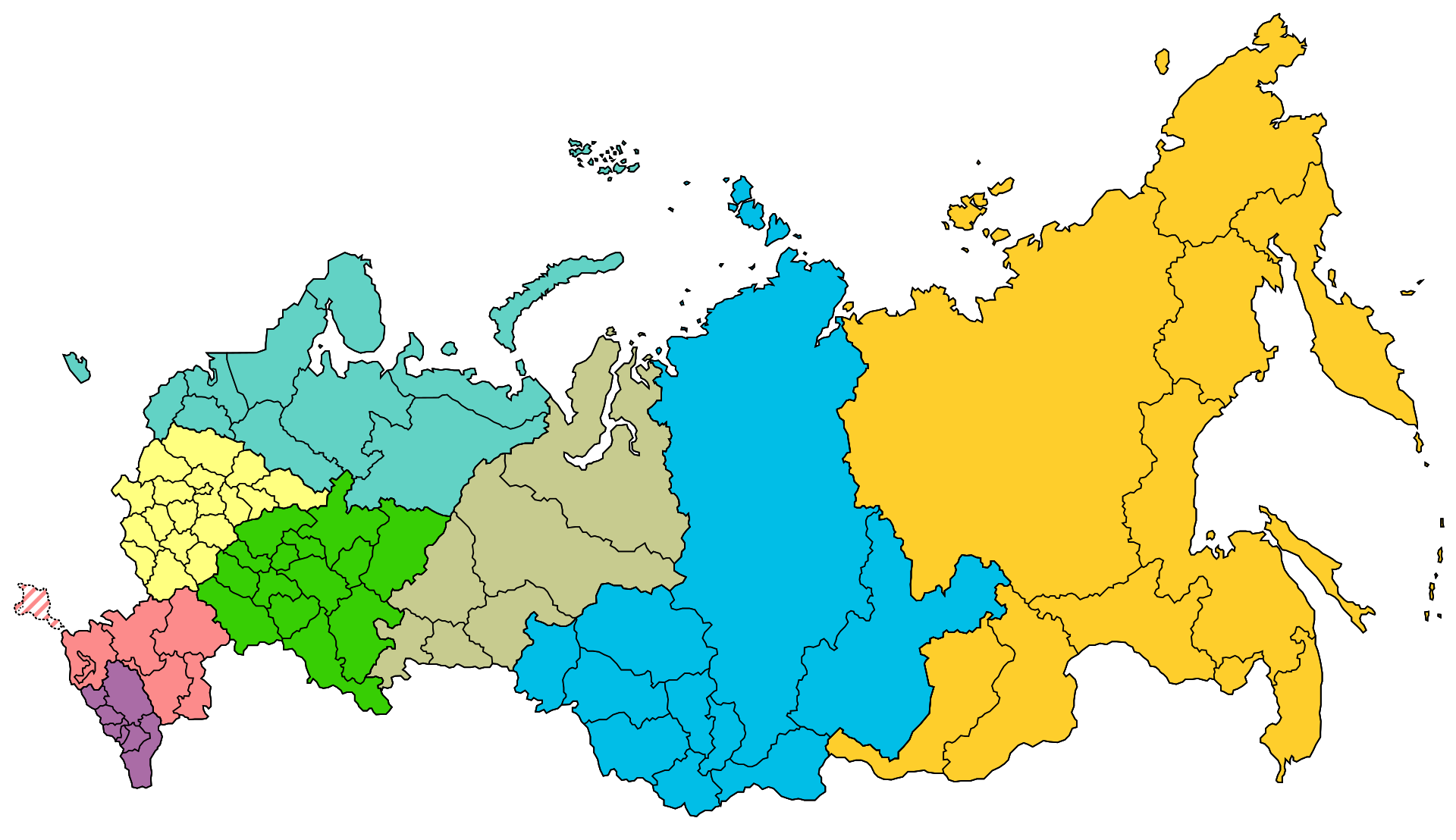
The federal districts of Russia were created to strengthen the "vertical of power," according to Decree No. 849 issued by Russian President Vladimir Putin titled "On the Plenipotentiary Representative of the President of the Russian Federation in a Federal District," dated May 13, 2000. At their establishment in 2000, seven federal districts were created.
| № | Name of Federal District | County District (km²) | Population 2025 | Population density. (people/km²) | Administrative center (city) | Natural population increase (%) 2022 |
|---|---|---|---|---|---|---|
| 1 | Central | 650 205 | 40 298 690 | 61,98 | Moscow | −4,9 |
| 2 | North-Western | 1 686 972 | 13 876 648 | 8,23 | St.Petersburg | −5,3 |
| 3 | Southern | 447 821 | 16 589 069 | 37,04 | Rostov-na-Donu | −5,3 |
| 4 | Northern Caucasus | 170 439 | 10 310 935 | 60,50 | Pyatigorsk | 4,9 |
| 5 | Volga region | 1 036 975 | 28 408 677 | 27,40 | Nizhny Novgorod | −5,4 |
| 6 | Uralsky | 1 818 497 | 12 282 737 | 6,75 | Yekaterinburg | −2,3 |
| 7 | Siberian | 4 361 727 | 16 492 894 | 3,78 | Novosibirsk | −4,8 |
| 8 | Far Eastern | 6 952 555 | 7 860 278 | 1,13 | Vladivostok | −3,2 |
| Russian Federation | 17 125 191 | 146 119 928 | 8,53 | Moscow | −4,0 |
The first change in their number and composition occurred on January 19, 2010, under President Dmitry Medvedev, with the formation of the North Caucasian Federal District, which was split from the Southern Federal District, increasing the total number to eight. The second change was the creation of the Crimean Federal District on territories annexed by Russia from Ukraine in 2014. The third adjustment was merging the Crimean district back into the Southern district in 2016. Subsequently, there was one change in the composition of districts without altering their total number, specifically transferring the Republic of Buryatia and Zabaykalsky Krai from the Siberian Federal District to the Far Eastern Federal District in 2018. Shortly after this transfer, the administrative center of the Far Eastern District was moved from Khabarovsk to Vladivostok within the same year. The only district name change was initially renaming the North Caucasian District to the Southern District on June 21, 2000, before the subsequent creation of the new North Caucasian District.
The Central Federal District is the largest by population size, population density, and the number of constituent entities, whereas the Far Eastern Federal District is the largest by territorial size. The smallest district in terms of territory is the North Caucasian Federal District; the Far Eastern Federal District has the lowest population size and density, and the Ural Federal District has the fewest constituent entities. Neither the Ural nor Central District includes republics among their constituents—the former includes autonomous districts within one region, while the latter consists solely of regions and a federal city. The North Caucasian District does not include any regions (though it has one territory) and is the only district without an absolute ethnic Russian majority. The highest proportion of ethnic Russians is in the Central Federal District.
All districts have land borders with other countries. The Northwestern and Far Eastern Federal Districts include entities without land borders connecting to other entities or the main territory of Russia. The Central, Volga, and North Caucasian districts do not have access to the world's oceans, though the latter borders the internationally recognized Caspian Sea-lake. The Volga Federal District has the largest share of industrial and agricultural production in Russia's economy; the Ural Federal District contributes the highest tax revenues, significantly shaping the federal budget.
In 2022, four new subjects (territories annexed from Ukraine) were included in the Constitution of the Russian Federation, which as of early 2024 were not part of any federal district. On June 6, 2024, Yevgeny Balitsky, appointed by Russia as governor of Zaporizhzhia Oblast, announced that a new federal district would soon be created, comprising all territories annexed from Ukraine, including Crimea and Sevastopol