
Why and How Anton Chekhov went to Sakhalin
by Donald RayfieldFor the book by Oleg Klimov Calamity Islands
In spring 1890, Anton Chekhov astounded his critics, publishers, readers, family, friends (especially the women who loved him) by setting off on a journey that seemed pointless, suicidal and out of character. He was crossing Siberia overland (when railway construction had barely begun beyond the Urals) at the worst season of the year when temperatures were still freezing, but molten snow was turning the enormous rivers that cut the route from south to north into mile- wide dangerous torrents. His tuberculosis had already resulted in severe haemorrhages, warn- ing him that he would soon share the fate of his consumptive relatives — he was still mourning the death of his older brother Nikolai the previous year — and this journey would be an ordeal that would inevitably reduce his life expectancy. Few people, unless they were convicts or ward- ers sent there by the authorities then went to Siberia, except for occasional foreign journalists.
The island of Sakhalin, recently acquired as part of an enormous far-eastern territory ceded by the weakened Chinese government, was regarded as the least habitable of Russia’s Arctic acqui- sitions. It was reserved for the worst criminals: one of those areas of the Russian empire where the death penalty was still imposed for murder and other crimes. The island’s sole inhabitants were 10,000 convicts, a few of their family members, hundreds of officials in the prison system and the few thousand hunter-gatherer Nivkh aborigines who had survived the epidemics and atrocities inflicted by Russian colonisers.
Why did Anton Chekhov embark on this rash enterprise? Ever since his school days, he had shown a capacity for rational decision-making. From his choice of medicine as a career to his steady development as a writer, beginning with short pieces for comic magazines and rising in a decade to become Russia’s finest and most widely recognised writer of prose fiction. But a conflict between medicine (‘my legitimate wife’) and literature (‘my mistress’) had already caused him suddenly to abandon one for the other. The likely fate of a Russian doctor — to live on slender means, even in penury, and to die of typhus, diphtheria, cholera or tuberculosis caught from a patient — might seem to overweigh the prestige of belonging to a respected and newly authoritative professional status.
SUBSCRIBE TO RECEIVE NEW TEXTS AND PHOTO STORIES
BY OLEG KLIMOV
On the other hand, the life of a writer, dependent on the whims of publishers who might pay 5 kopecks or one rouble a line, of censors who could ban a book, of readers who might take offence at an author’s ideological bent. It was a career which involved frequenting circles whose Bohemianism repelled a fastidious nature and made men like Chekhov feel guilty at not contributing to the public good.
For decades the writings of Dostoevsky (Notes from the House of the Dead) and Tolstoy (Resurrection) had portrayed Russia’s and Siberia’s prisons as a purgatory where the prisoners might be less guilty and more worthy than their judges and warders. To a certain extent, European and American protest against such horrors as Australia’s Botany Bay or French Guyana’s Devil’s Island had brought questions of reform, retribution and the abolition of flogging into the public forum.Chekhov’s proposal to report on the worst of Russia’s prison colonies (and to inspect other prisons on the way) was not, in fact, original. The American George Kennan had carried out an extensive expedition in 1885 and 1886, although his book on the subject was not published until 1891, shortly after Chekhov himself returned from Sakhalin.
Chekhov was not encouraged by his friend and publisher Aleksei Suvorin, the influential owner and editor of Russia’s one authoritative, albeit conservative newspaper New Times. Even though Suvorin was willing to subsidise Chekhov’s journey and to publish any articles he wrote about his travels, he saw no good reason to antagonise the authorities by denouncing their penitential system and, in fact, he sabotaged the journey by failing to send out promised letters of introduction to Siberian governors.
Chekhov, on the other hand, had an almost filial liking for Suvorin and a great deal of common ground with him. Both men came from humble backgrounds, and both had unhappy family circumstances — Chekhov was weighed down by his feckless older brothers, Suvorin betrayed by his two wives and his three sons. But Chekhov was often embarrassed by seeming to be com- plicit with, even patronised by a reactionary Petersburg publisher, when his fellow writers sided with more liberal Moscow publishers. The journey to Sakhalin offered the prospect of a breach with reactionaries.
Partly because of his association with Suvorin, Chekhov was accused by radical critics of being indifferent to the human suffering his stories portrayed. Certainly, Chekhov perturbed Russia’s critical establishment by his political and ideological neutrality, by his implication that literary heroes’ philosophising was just male self-preening mating display. Critical responses stung Chekhov: he decided to demonstrate his sympathy for the downtrodden and his disapproval of their oppressors by the Sakhalin journey, an action far more drastic than anything his critics had undertaken.
While Chekhov had until 1890 shown no more than a schoolboy’s interest in travel and explo- ration, his nascent Wanderlust showed itself when he wrote an anonymous panegyric obituary in 1888, lauding the explorer of Central Asia Colonel Nikolai Przhevalsky as a man more edify- ing than a thousand schools. Chekhov’s route to Sakhalin would follow, as far as the Amur river, the route of Nikolai Przhevalsky’s first exploration.
In the 1890s, probably when Chekhov read more of Przhevalsky’s disturbing accounts of ruth- less arrogant behaviour, he realised that the man he had praised was no ordinary hero, but a vicious conquistador, uninterested in the peoples or cultures of Mongolia and Tibet, except as evolutionary relics that should be superseded, even exterminated, so that Russian Cossacks could occupy their territories. In his post-Sakhalin novella The Duel, Chekhov portrays the Przhevalsky - like zoologist Von Koren as a doctrinaire Darwinist who tries to murder a man whom he considers to be a surplus weakling.
Private reasons, however, dominated Chekhov’s decision. It was not just his brothers and par- ents who were an intolerable burden (one brother was desperate to accompany him and had to be dissuaded), but a number of women friends whose love for him he could never fully requite. Lika Mizinova, a beautiful schoolteacher, whom he had courted so intensely that he feared he would have to propose to her, was most on his mind; Olga Kundasova, a psychologically frail and very intense intellectual, actually insisted on travelling with him on the first stage of his journey. Faced with impossible demands for a response, not for the last time, Chekhov ran away, in the hope that time would lessen others’ insistent desires for his company.
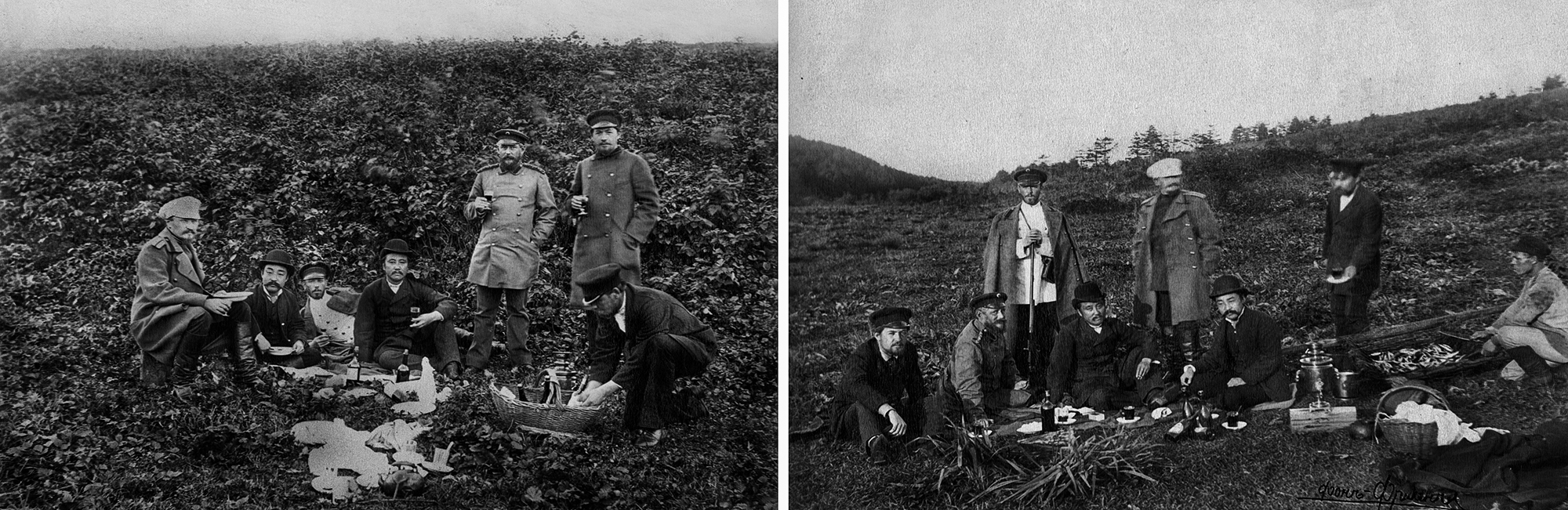
Chekhov’s journey was eventful: he was nearly killed when thrown from his wagon; days were spent waiting in freezing sleet for a ferryman across major rivers. He had equipped himself bad- ly: a heavy leather bag which offered no comfort when lying on an unsprung wagon, a revolver which he had no occasion to use (although every one of his plays involves one).
The company he found on the journey was unprepossessing: an officer being exiled to Siberia for beating his batman; a police chief who insisted on showing Chekhov around the brothels of a Siberian city; a Chinese traveller who regaled him with tales of decapitation. His only high point was a visit to a Japanese-staffed brothel in Blagoveshchensk where, to judge by his letter to Suvorin, his experience was like an ‘advanced lesson in equitation’.
Once he had reached Sakhalin, he found a surprisingly friendly reception from both convicts and warders: he was allowed to print 10,000 questionnaires at the official print-works and began a census of the prisoners. His questions were too basic — including age, origin, state of health — to be of real sociological use: they did not give much insight into criminality. But over three months he exhausted himself investigating the ramshackle hospitals (where the only medicine was brandy which the doctors drank), the frightful prisons with their flogging stools, gallows and the wheelbarrows to which many convicts were chained, crippling them for life.
Prisoners took a liking to him: a merchant convicted of arson gave him a hand-carved spoon; warders showed their best side, so that notoriously cruel psychopaths astounded their acquaintances with the favourable portrait Chekhov drew of them. He did not understand all the prisoners’ jargon, but was moved to a new conviction: that the criminals were better men than their guards and judges.
All the same, when he departed (this time in the comfort of a ship that took him via Hong Kong and Sri Lanka to Odessa), he was convinced he had observed everything but missed the elephant in the room. He obliterated the memory of horrors by an encounter with a Tamil prostitute in Sri Lanka and by purchasing a pet mongoose and a savage civet cat, which would amaze and torment his family when he returned to Moscow.
What were the results of this foolhardy expedition? Chekhov lobbied the authorities and those aristocrats with whom he could bear to be in touch to send school books, so that the education of prisoners’ children could become less of a pretence; he complained of the lack of medical treatment, of the cruel physical punishments, of the reduction of prisoners’ wives to prostitution. By all accounts, some modest reforms did ensue, but Sakhalin remained a blot on Russia’s reputation. The island had little economic value except as a coaling station for shipping, and, being just a colony for Russia’s worst criminals, it attracted only the most desperate officials.
On his return, Chekhov was disappointed by the public’s lack of interest in his descriptions, which he worked into a book. He presented it to Moscow University as a doctoral thesis, but it was rejected — possibly because Chekhov was by now notorious as a writer who satirised academics. Readers of Chekhov were puzzled that his later work hardly ever mentioned Sakhalin. Nevertheless, there was a profound change. After 1890 great men play no part in Chekhov’s stories. There are no more distinguished professors of medicine, as in A Dreary Story, nobly facing death. The poor, the oppressed and the deluded receive far more sympathy, while authority is shown as callous and myopic.
In his last years, when tuberculosis exiled Chekhov to the Crimea, the headmistress of the Yalta girls’ school asked him why Sakhalin played such a small role in his work. Chekhov responded by asking her whether she didn’t think that all his late work had been ‘sakhalinated’.
Donald Rayfield, writer and professor of Queen Mary University, London, spring 2020
Call to action
View and purchase the Calamity Islands photobook.