
The Seven AI Samurai
In Akira Kurosawa's famous film Seven Samurai (1954), a vast social gulf separates the peasants from the samurai. The peasants fear the samurai and do not trust them. The samurai, members of the warrior class, are accustomed to looking down on the peasants. But circumstances force both sides to overcome their mutual hostility.
The peasants need protection from bandits. They offer the samurai modest payment: rice, barely enough to keep them fed. And yet the samurai agree to defend the village.
Their decision is motivated not only by necessity and compassion, but also by notions of warrior honour, traditionally associated in medieval Japan with bushido (武士道) — the "way of the warrior."
In Kurosawa's film, seven samurai defend a village against the bandits of medieval Japan.
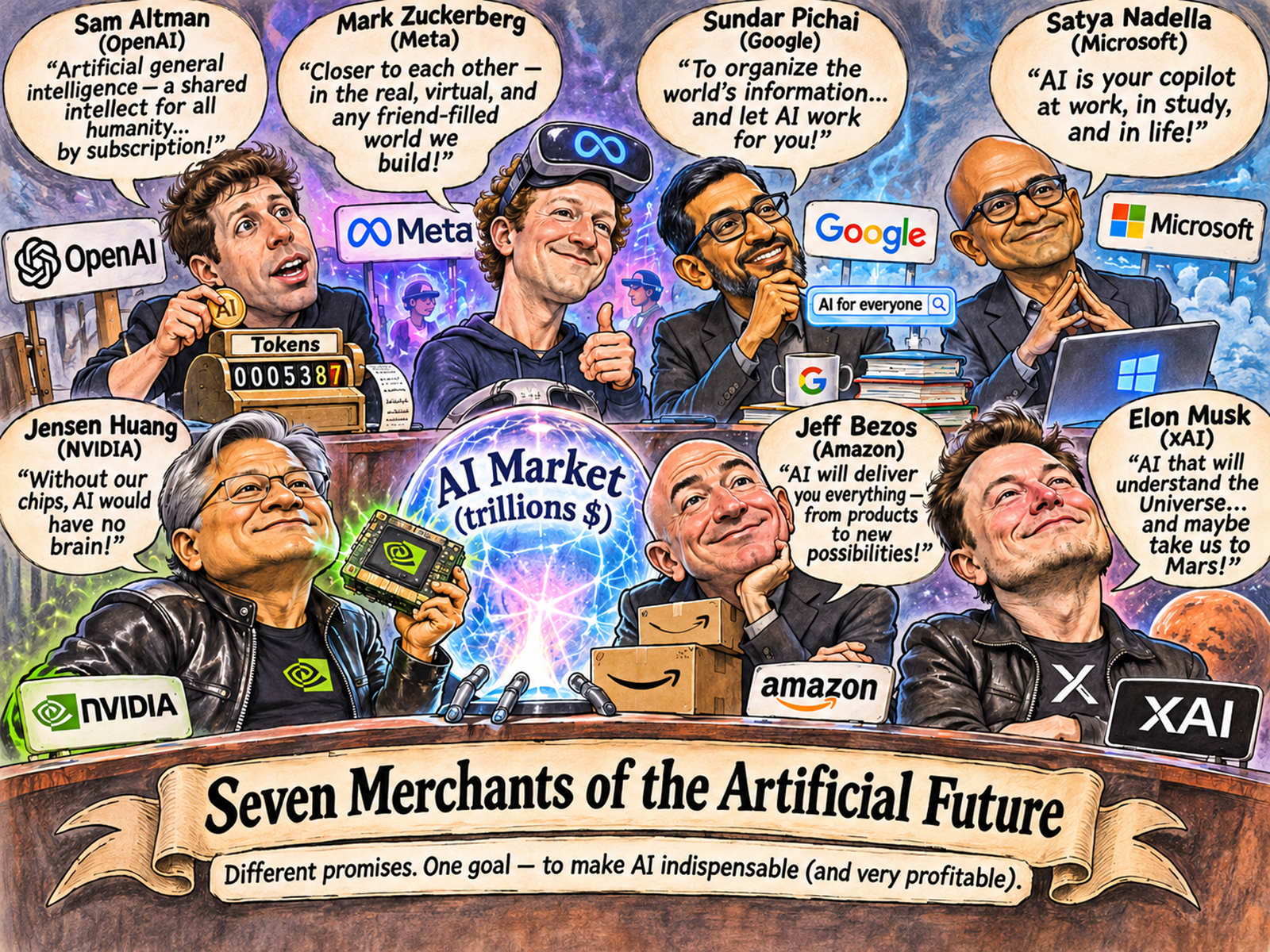
In our modern story, seven technology magnates (see the illustration generated by my AI agent Marusya / OpenAI) promise to protect humanity from the dangers of artificial intelligence — the very technology they themselves are developing.
There is, however, one significant difference. Kurosawa's samurai did not create the bandits. Our AI samurai, on the other hand, are simultaneously developing the technology, warning us about its potential dangers — including the possible extinction of humanity — and offering us their services.
So it might be useful for us, the modern-day "peasants," to find out what the bushido of artificial intelligence actually looks like.
What code of honour guides its creators? And whom, exactly, are they planning to protect?
What Are the AI Samurai Selling Us Peasants?
You may be surprised, but it isn't rice. They are selling us tokens. Not grain by grain, but by the handful, by the sack, and by the trainload.
A token is a unit into which a neural network model divides the text it processes. It may be an entire word, part of a word, an individual character, or even a punctuation mark.
Unlike a human being, a computer does not understand words. To process a text, the system first breaks it into tokens. Each token corresponds to a numerical identifier — an ID drawn from the vocabulary of a particular tokenizer.
These identifiers are then transformed into numerical vectors, which the neural network processes. Based on the context, the model calculates the probabilities of possible next tokens and gradually constructs its response.
Probabilities, not guaranteed statements of fact.
That is why, beneath the ChatGPT window, you may find a warning: "ChatGPT can make mistakes. Check important info."
This is not merely a legal precaution. It is important to understand, especially if you did not study mathematics at school or university. It is a reminder of how the technology works — a technology we are increasingly willing to trust with writing, document analysis, programming, and finding answers to complicated questions.
But let us return to business.
The cost of processing tokens depends on the model. API pricing distinguishes between input tokens — the text supplied to the system — and output tokens, which make up its response. Moreover, the same text in different languages may require a different number of tokens.
Take GPT-6.1 Sol, for example. According to OpenAI's standard API rates for November 2026:
-
1,000 input tokens cost $0.002.
-
1,000 output tokens cost $0.01.
-
100,000 output tokens cost $1.
You can check for yourself how many tokens your question — or anything else you say to OpenAI — will require using the OpenAI Tokenizer.
For example, the Latin phrase "In vino veritas" takes four tokens, while its Russian translation, "Истина в вине", takes five. (Now do you understand why French wine costs more in Russia?)
At first glance, tokens cost next to nothing. But these are the selling prices of computing services, not their actual production costs.
We do not know exactly how much it costs a company to produce each token. AI companies do not disclose this information. We can estimate the costs of computing, electricity, equipment depreciation, and the development of new models, but we do not have access to their complete internal calculations.
And this is where things become interesting.
The AI Samurai Are Living on Borrowed Money
A token may generate an operating profit for a company while the company itself continues to make enormous losses.
The reason is the huge cost of developing new models, conducting research, building infrastructure, employing staff, and promoting products.
According to published financial documents, OpenAI's revenue in 2025 amounted to approximately $13.1 billion, while its operating loss reached nearly $20.9 billion.
In other words, the company has already learned how to sell artificial intelligence for enormous sums of money. But it has yet to demonstrate that the continuous development of increasingly powerful AI models can become a sustainably profitable business.
It is important, however, not to lump all seven together.
OpenAI and other specialised AI model developers depend heavily on attracting investment capital, whereas Google, Microsoft, Meta, and Amazon can finance their AI investments through other, already profitable parts of their businesses. NVIDIA, meanwhile, earns most of its money by selling computing hardware. Nevertheless, the entire AI industry requires colossal investment.
And what does that mean?
Investors are promised a revolution in the global economy. Users are promised intelligent assistants that will become indispensable. Society is promised a future in which artificial intelligence will solve almost all of humanity's problems.
Paradoxically, at the same time, the leaders of these companies warn us about the risks posed by the very technology they want us to buy.
It amounts to a peculiar form of trading in the future: first we are told how inevitable it is, then how dangerous it will be, and finally we are invited to take out a paid subscription.
But what happens if investors one day stop financing the rapid development of AI and demand sustainable profits instead of promises? Will artificial intelligence remain as accessible as it is today? Or are today's relatively inexpensive services merely a temporary phase, while the cost of the technological race is being covered by investment capital?
Where Will the Electricity for Our Digital Future Come From?
There is another side to this story, one that receives considerably less attention in corporate presentations. Artificial intelligence requires not only money but also enormous computing power. And computing power requires electricity.
This is no longer simply a financial risk. It is a very real physical limitation. The problem is not that humanity will necessarily run out of electricity. The problem is that the necessary power capacity is not always available precisely where — and when — new data centres need it.
According to forecasts by the International Energy Agency (IEA), data centres could account for approximately 3% of global electricity consumption by 2030.
At first glance, that does not sound like much. But in the United States, for example, the picture is already very different.
According to calculations by Lawrence Berkeley National Laboratory, data centres could consume between 9.5% and 15.3% of the country's total electricity supply by 2030.
These figures refer to all data centres, not only those serving artificial intelligence. Nevertheless, the rapid development of AI is becoming one of the main drivers of increasing demand.
The IEA also warns that limitations in electricity grids could delay the connection of roughly 20% of the data-centre capacity planned for 2030.
Computer technologies are developing faster than power stations, transmission lines, and transformer substations can be built.
And here we encounter the paradox of the digital revolution:
The speed of artificial intelligence development increasingly depends on the speed at which we can build very physical structures made of concrete, steel, and copper.
The Environmental Footprint of Invisible Intelligence
The third systemic limitation is environmental.
Artificial intelligence is often presented as an almost immaterial technology: algorithms, neural networks, data, digital models, virtual assistants. Yet behind this invisible intellectual machine stands an enormous material industry.
Mining. Semiconductor factories. Power stations. Water supply and cooling systems. Data-centre construction. The manufacture and disposal of computer equipment.
Modern computing centres do not merely consume electricity. Depending on the technologies they use, they may require substantial quantities of water, generate continuous noise, and increase the burden on local infrastructure.
Backup generators can contribute to air pollution, while semiconductor manufacturing involves the use of chemicals and the production of industrial waste. The environmental costs, meanwhile, are distributed very unequally.
A user in one country enjoys a convenient service. A company in another sells a subscription. An investor in a third hopes for future profits. Meanwhile, residents of a small town where a large data centre has been built may face noise, additional pressure on electricity networks, and competition for water resources.
These residents may not own a single share in OpenAI, Microsoft, NVIDIA, or Google. Yet the consequences of the global artificial intelligence industry may be unfolding literally outside their windows.
According to a study published in Nature Computational Science, the projected cumulative volume of electronic waste associated with generative AI between 2020 and 2030 could range from 1.2 million to 5 million tonnes, depending on the scenario.
Who Pays for the Future?
And now we come to the fourth problem — perhaps the most important of all.
Who receives the economic benefits of artificial intelligence, and who bears the costs of its development?
This question is not simply about how much money OpenAI earns or how much electricity data centres consume. It concerns the distribution of resources, profits, responsibilities, and the right to make decisions.
Who owns the infrastructure of the future digital economy? Who decides where data centres should be built? Who pays for expanding electricity networks? Who controls water consumption? And do local residents have the right to influence these decisions?
This does not mean that the development of artificial intelligence must be stopped. I certainly do not advocate that. But the construction of new computing centres, environmental restrictions, and the distribution of economic benefits should be matters of public debate. That debate must involve not only the "seven samurai" and government officials, but also local communities.
This is precisely where the technological revolution becomes a question of civil rights.
And What About Bushido?
Let us return to Kurosawa.
In his film, despite the prejudices separating the social classes, the samurai ultimately become the defenders of people who possess neither power nor wealth. They risk their lives for those who cannot adequately reward them for their protection.
Our seven AI samurai inhabit a very different world. They run corporations, control enormous amounts of investors' capital, and compete for control over the technologies that will shape our future. And nobody is asking them to practise medieval self-sacrifice.
But if they genuinely claim to be the protectors of humanity, one would like to know whether they have a code of responsibility of their own. Not a marketing slogan about a wonderful future, but concrete obligations towards the people who will have to live with the consequences of their decisions.
Perhaps the most important question is not even whether artificial intelligence will one day surpass human intelligence.
It is whether human beings will be able to preserve their right to determine their own future in a world where an increasing share of opportunities and resources is concentrated in the hands of a few technology corporations.
At the end of Kurosawa's film, the samurai leader Kambei makes a bitter observation: once again, it is the peasants who have won, not the samurai.
I wonder who will emerge victorious in our story. For now, the samurai are merely sending out the bills. And the peasants are paying.
Oleg Klimov, Photographer's Diary. November 2, 2026.
Sources
-
International Energy Agency — Key Questions on Energy and AI
-
Lawrence Berkeley National Laboratory — U.S. Data Center Energy Usage Report
Available for Editorial Assignments
Photographer's Diary
Subscribe
Telegram
Subscribe to my Telegram channel for new photographs, field notes, and updates on my documentary projects.