
If You Don’t Know What to Do, Go to War
Approximate reading time: 6–7 minutes. По-русски

Hello photographers,

This week’s brief is not about Russia, not about women, and not about the usual carousel of open calls. It is about a grant — and about the photographer whose name it carries.

The Stanley Greene Foundation Emerging Photographers Grant 2026–2027 is open for applications. The grant offers $10,000 to visual storytellers at the beginning of their careers, helping them develop strong documentary projects with human meaning and urgency.

The deadline is July 1, 2026, at 11:59 p.m. EDT. Applications are submitted through Picter.

Good luck!
For me, it is impossible to speak about this grant only as a competition. The name of Stanley Greene is not a formality in the foundation’s title. For many photographers of my generation, that name is connected with war, freedom, style, pain, stubbornness, and that strange human condition in which photography stops being a profession and becomes a way of not looking away from what is happening.
All photographers know one another — less often personally, more often through photographs. Sometimes the photographer is no longer alive, yet his life continues in a strange and beautiful way through his images: through the gaze that the camera fixed for a long time, far longer than a human life. This is one of photography’s beautiful functions — to prolong life, to preserve memory, and to introduce people to one another beyond time and space.
I was not a close friend of Stanley’s. He appeared in my life in some unexpected way and disappeared just as quickly, as if returning to a world of his own, a world to which only he knew the way. More often this happened in war, less often at exhibitions, festivals, or in shared projects.
In a sense, he was for me a continuation of the “American dream” in Russian photography. In the early 1990s, that “dream” was brought to Moscow by Lucian Perkins, Bill Swersey, Anthony Suau, Time magazine photo editor Mark Rykoff, and other American photographers.
Perhaps InterFoto was one of the most significant events of those years. It introduced the world to the names of Soviet nonconformists from the late USSR — Vladimir Syomin, Valery Shchekoldin, and Yuri Rybchinsky. At the same time, InterFoto became one of the forces behind the emergence of a new wave of Russian photography.
Young photographers were filled with a sudden sense of freedom and newly opened possibilities. American photographers were discovering the USSR and young Russia, while Russian photographers were discovering photography from the rest of the world.
On that wave of freedom, an American with a “black passport” appeared in Russia. His name was Stanley Greene.
We first met by chance in a Moscow photo lab in 1993. Waiting in line to have our films developed, he casually told me the story of how he had nearly been killed inside the White House during the shelling of the Russian parliament in the center of Moscow. In response, I told him that at that very same time I had been nearby, in the Hotel Mir — a hotel that no longer exists — photographing tanks firing at the White House, where he was inside with other journalists.
That was enough for us, over the next twenty-something years, to say “hello” to each other whenever we met.
Stanley Greene was always surrounded by women. Beautiful women. Even in war, where fear, horror, and dirt reigned everywhere. It seemed there was no place there for beauty, but wherever Stanley was, beauty somehow appeared. It could be a fixer, an interpreter, or a journalist — it was a woman. A beautiful one.
In 2004, during the project One Day in the Life of Lithuania, one could notice a solitary photographer in the lobby of a hotel in central Vilnius. On his head he wore a black beret with a red star and a green “Ichkeria” sticker. He sat in an armchair in front of a huge window, looking out at the night city without getting up. This continued for several nights in a row.
The man in the armchair was Stanley Greene. A woman had left him. A beautiful one.
The photographers — participants in the project from all over the world — tried to support him, to cheer him up, to pull him out of that state. But it seemed that nothing could help him. He continued to sit in his armchair with the look of a man who had lost everything in a single moment.
“If you don’t know what to do, go to war,” I said, handing him a glass of whiskey.
Stanley drank, smiled, and answered:
“I always do that. I’ll go this time, too.”
It was not only Stanley Greene who acted this way. Many war photographers I knew in those years did the same. Today one can name many reasonable motives that drive a photographer to go to war: professional duty, an interest in history, the desire to bear witness, the search for truth, an editorial assignment, adrenaline, vanity. All of this may be true. But in all these explanations, the main motive is almost always missing — the personal and irrational one.
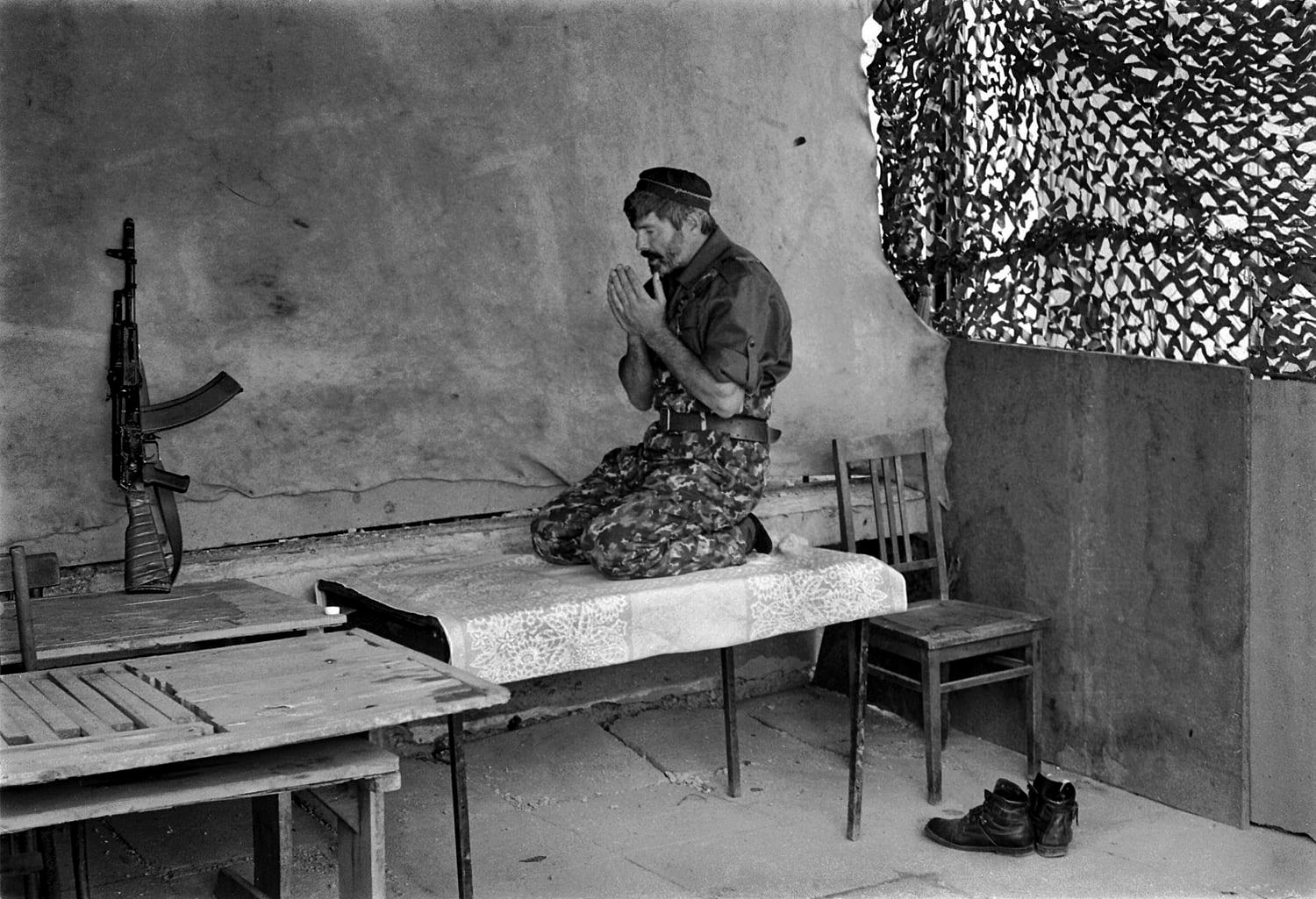
Stanley Greene was not a photographer who simply came to war and then left it. He stayed there longer than the profession required. Chechnya became for him not only a subject, but a wound. His book Open Wound: Chechnya 1994–2003 bore exactly that title — an open wound. It was not a metaphor of style, but rather a form of existence. He photographed war as a man who could not accept what he saw, and could not pretend that it had nothing to do with him.
I do not think Stanley Greene directly changed the institutions of contemporary Russian photography. With the loss of freedom — the necessary condition for any creative work — mediocrity, imitation, and a new ideology once again flourished in Russia: notions incompatible with Stanley Greene’s photographs.
But his impact on several generations of Russian photographers was significant. Not as a school, not as a method, not as a style that could be repeated. Rather, as an example of the fact that photography can be a human act.
That is precisely why the grant in his name matters. A young photographer needs money, of course. Deadlines, editors, journeys, time, equipment, access, and trust are also needed. But sometimes he also needs the example of a person who has already gone where it was frightening to go, and did not turn away.
If this photographic tradition continues, tomorrow photography may become more humane than it was yesterday. And every photographer, finding himself in a moment of confusion, may perhaps better understand what to do and what to photograph.
Oleg Klimov
Weekly Brief, May 31–June 6, 2026. Photographer’s Diary
Available for Editorial Assignments
Photographer's Diary
Subscribe
Share the story — make the world freer: